
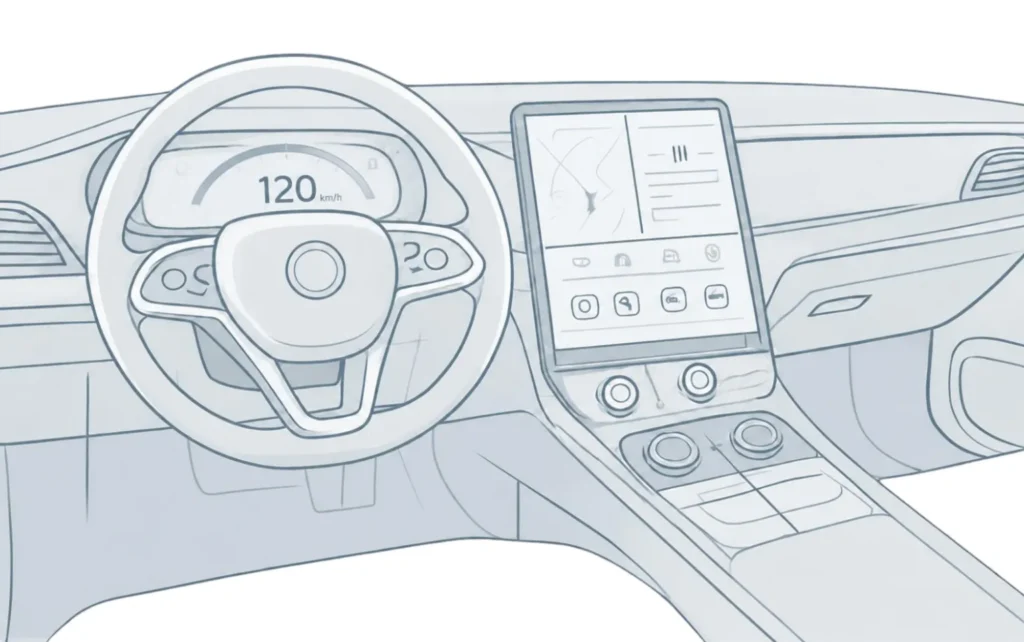
A recent article from Autocar covering Polestar’s decision to bring back more physical buttons based on owner feedback highlights an important shift happening across the automotive industry.
The conversation is finally evolving beyond a simplistic debate of “physical switches are the past, screens are the future.”
That is a good thing for drivers—and a good thing for automotive UX.
For years, the industry has been pushing aggressively toward screen-centric interiors. The reasons made sense: flexibility, modern aesthetics, software-defined functionality, personalization and the ability to continuously evolve the in-vehicle experience.
But real-world usage matters.
And increasingly, automakers are recognizing that great user experiences are not created by maximizing screen space alone.
They are created by understanding how humans naturally interact with vehicles.
Great UX Is About Balance
Drivers interact with vehicles differently depending on context.
Sometimes touchscreens are the ideal interface:
- Navigation
- Visualization-heavy workflows
- Vehicle settings that are accessed while parked
- Videos and other media (again, accessed while parked)
- Personalized digital experiences
Sometimes physical controls are simply better:
- Frequently used functions
- Eyes-free operation
- Muscle-memory interactions
- Climate adjustments
- Immediate access to key controls
And increasingly, voice interaction is becoming another essential element:
- Natural-language commands
- Reduced distraction
- Faster access to complex functions
- Improved accessibility
The best vehicle experiences do not overconcentrate a single interaction philosophy.
They are built around choosing the right interaction method for the right moment.
Human-Centered Design Matters More Than Trends
At first glance, some might assume companies focused on automotive graphics and digital cockpit software would naturally advocate for “all-screen” interiors.
At Altia, we see things differently.
Our focus has never been about replacing every physical interaction with a display.
Our focus is helping automakers create exceptional user experiences.
Sometimes that experience is driven by beautiful graphics and immersive displays. Sometimes it depends on tactile physical controls. Sometimes voice is the best option. Often, the best systems combine all of them together seamlessly.
Great automotive UX is not about forcing drivers to adapt to technology.
It is about designing technology that adapts naturally to drivers.
The Industry Is Entering a More Mature UX Phase
The automotive industry’s early push toward minimalist interiors helped accelerate innovation in digital cockpits and software-defined vehicles.
But the next phase of automotive UX is becoming more refined and more user-centered.
OEMs are increasingly recognizing that:
- Bigger displays do not automatically improve usability
- Minimalism can sometimes increase cognitive load
- Driver distraction matters more than visual novelty
- Different functions deserve different interaction models
- Long-term satisfaction matters more than design trends
This is not a retreat from innovation.
It is progress toward smarter, more thoughtful design.
Flexible Platforms Enable Better Experiences
Modern vehicle UX is incredibly complex.
Automakers must orchestrate:
- Multiple displays
- Touch interaction
- Physical inputs
- Voice systems
- Haptics
- Real-time graphics
- Safety requirements
- Brand differentiation
- Embedded hardware constraints
Creating cohesive experiences across all these systems requires flexible, production-proven technology.
That is why Altia helps automotive teams build HMIs that integrate digital displays, physical interaction models, animations, voice workflows and branded experiences into a unified interface strategy designed for real drivers and real-world usage.
Because ultimately, the future of automotive UX is not “all screens.”
It is intelligent, adaptive interaction design.
And the companies that get that balance right will create the vehicle experiences drivers trust, enjoy and remember most.