
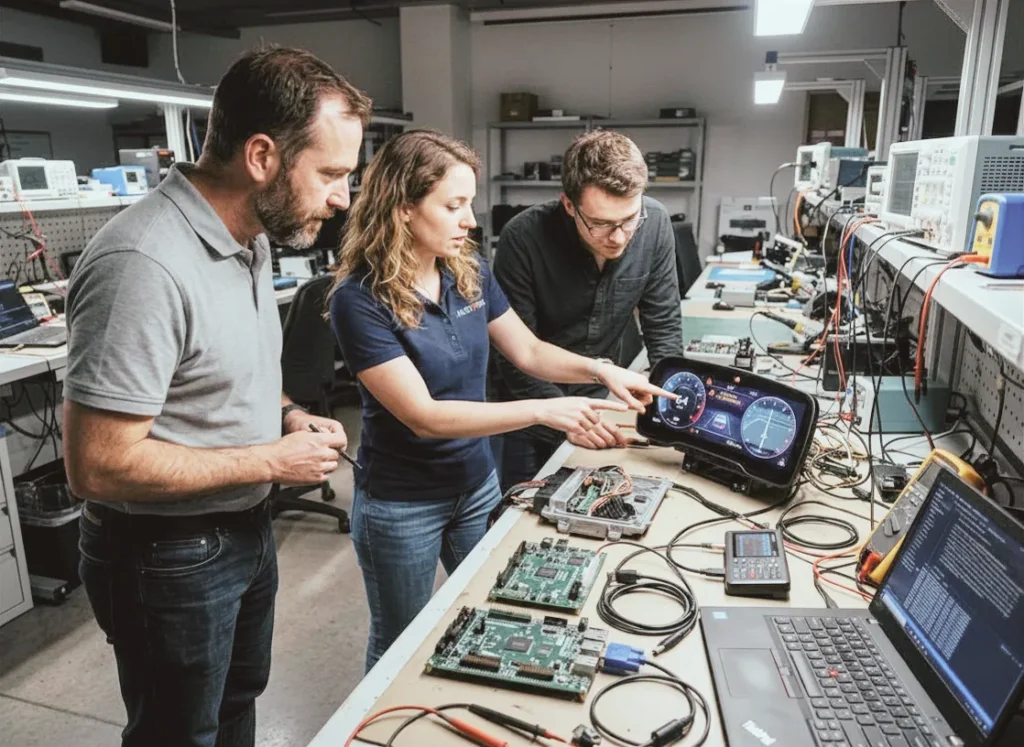
How one team rescued their QML investment and shipped on lower-cost hardware
A leading automotive supplier came to Altia with a problem familiar to many embedded development teams: they had invested heavily in a QML-based UI for a combined instrument cluster and radio, the design looked good in the prototype environment, and then reality hit. When it came time to target production hardware, the resource demands of their Qt-based toolchain made the originally planned processor and memory configurations untenable. The project wasn’t moving forward. They were stuck.
“We found ourselves at a dead-end with Qt. We were able to get something on screen to prototype, but when we looked at what it would actually take to ship it, the hardware costs were a serious problem.”
Rather than scrapping the work, the team brought their existing QML assets to Altia. Altia’s services team leveraged those assets and converted them into highly optimized, native Altia designs and, ultimately, C code—no heavyweight runtime, no interpreted layer, no rewrite from scratch.
The results were significant. On comparable hardware targets, Altia’s generated code used roughly two-thirds less SRAM than a Qt-based implementation and nearly half the framebuffer memory. That headroom translated directly into bill-of-materials savings and opened the door to lower-cost processor options that hadn’t been viable before.
The supplier shipped. The design intent was preserved. The hardware cost target was met.
Not Just an Automotive Problem
Teams in appliances, industrial equipment, medical and beyond face the same pattern: UI tools and design-centric workflows like QML or XML are effective for prototyping and stakeholder review, but they were not built for the constraints of embedded production targets. These are desktop- or mobile-focused tools. Memory footprint, startup time, deterministic behavior and product lifecycles require a different approach at the implementation layer.
Altia’s generated code technology bridges that gap. It takes assets from all sorts of modern tools and produces production-ready embedded software optimized for the actual hardware—not the developer’s laptop.
If your team has UI assets built in QML, XML, Figma or another design tool, those assets do not have to be a sunk cost. They can be the starting point.