
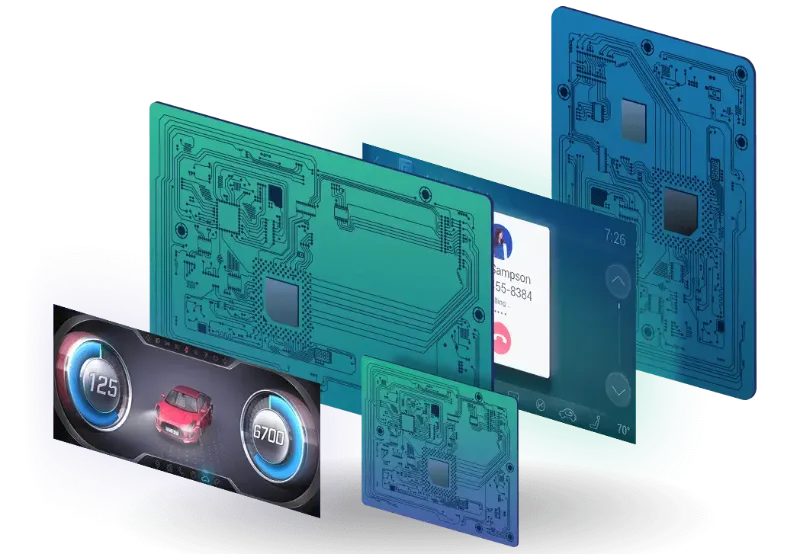
One Tool, Limitless Possibilities
Each Altia DeepScreen target is carefully architected to leverage the assets available on your selected platform. This means that you get the best balance of performance and BOM cost for your product. And because Altia supports a wide array of hardware targets, you have greater flexibility to swap hardware and scale your UI.
Check out our ever-expanding list of supported hardware platforms.
- Renesas R-Car E3e
- Renesas R-Car D/E/M/H
- Renesas Synergy S5/S7
- Renesas D1Lx
- Renesas D1Mx
- Renesas DR4-3D
- Renesas Dx4-H
- Renesas RX600
- Renesas SH7268/9
- Renesas RZ/A
- NXP i.MX 6
- NXP i.MX 8
- NXP i.MX 95
- NXP i.MX 93
- NXP i.MX
- RT1160/1170
- NXP i.MX RT1060 NXP S32V
- NXP S32V
- NXP MAC57D5xx
- NXP MPC5645S
- NXP MPC5606S
- NXP i.MX28
- NXP i.MX53
- NXP LPC1788
- NXP VFxxx
- Infineon PSoC™ 6
- Infineon XMC7200
- Infineon TRAVEO™
- T2G Infineon TRAVEO™ T1G S6J3200
- Infineon TRAVEO™ T1G S6J32DA
- Infineon TRAVEO™ T1G S6J33xx
- Texas Instruments AM62
- Texas Instruments AM3354
- Texas Instruments TDA4VM/DRA829
- Texas Instruments DRA7xx
- Texas Instruments TMS320C6748
- Samsung Exynos Auto V9
- Intel x86
- Intel Atom A3960
- Intel Atom 5
- Panasonic MN103SL33
- Panasonic MN103SM43
- Qualcomm Snapdragon 8xx
- Qualcomm Snapdragon SA8155/SA8195
- STMicroelectronics STM32MP1
- STMicroelectronics STM32H7
- STMicroelectronics STM32F4
- STMicroelectronics STM32F7
- STMicroelectronics STM32L4
- STMicroelectronics Accordo 5
- Telechips TCC807x (Dolphin5)
- Telechips TCC805x (Dolphin3)
- Telechips TCC803x (Dolphin+)
- Telechips TCC897x
- MediaTek MT2715
- MediaTek MT8195
- QNX Neutrino
- Green Hills INTEGRITY
- Linux / VxWorks / Nucleus
- OpenGL ES
- OpenVG
- Windows
- Android
- Apple iPhone / iPad
- Yamaha VC1N/VC1H
- Fujitsu Carmine/Jade
- Toshiba Capricorn

Don’t see your hardware here? Don’t worry.
Frequently Asked Questions
Altia supports a wide range of embedded hardware platforms from leading semiconductor providers including NXP, Renesas, Infineon, Texas Instruments, Qualcomm, STMicroelectronics, Samsung, Intel, MediaTek and Telechips. Altia continues to expand its list of supported hardware targets.
Yes. Altia DeepScreen supports a broad range of processors, microcontrollers and system-on-chip platforms, allowing development teams to deploy embedded GUIs across diverse hardware environments.
Each Altia DeepScreen target is architected to leverage the capabilities and resources of the selected hardware platform. This helps deliver the optimal balance of performance, memory usage and bill-of-materials cost.
Yes. Altia’s broad hardware support provides flexibility to migrate user interfaces between hardware platforms as product requirements, costs or supply chain conditions change.
Yes. Altia allows organizations to scale user interfaces across a variety of hardware platforms, from resource-constrained embedded systems to high-performance devices.
Altia supports a variety of operating systems and software environments including Android, Windows, QNX Neutrino, Green Hills INTEGRITY, Linux, VxWorks and others.
Yes. Altia supports Android as well as many other embedded operating systems, enabling organizations to develop and deploy GUIs on their preferred software platforms.
Yes. Altia supports QNX Neutrino, making it a strong option for automotive and other embedded applications that require a reliable real-time operating system.
Altia continuously expands its hardware support. If a target platform is not listed, organizations can contact Altia to discuss their specific hardware requirements and potential support options.
Altia offers Altia CloudWare, which provides remote access to hardware and Altia GUI development software so teams can benchmark, test and validate GUIs from anywhere.
Yes. Altia offers guidance to help organizations evaluate and select hardware that meets their user interface, performance and cost requirements.
Broad hardware support gives development teams greater flexibility, reduces vendor lock-in and makes it easier to adapt to changing performance requirements, component availability and product strategies. Altia is designed to support this flexibility across a wide range of embedded platforms.
Altia combines optimized code generation, hardware-specific performance tuning and support for a broad range of industry-leading processors and operating systems. This enables teams to deploy high-performance GUIs with confidence across multiple embedded platforms.