
更新于2026年11月
Head-up displays (HUDs) put speed, navigation and safety alerts directly in the operator’s line of sight, so eyes stay on the road, the water or the field. In 2026, HUDs are moving beyond premium cars into augmented reality, motorcycles and smart helmets, boats and heavy equipment, and the interface design matters more than ever.
What is a head-up display?
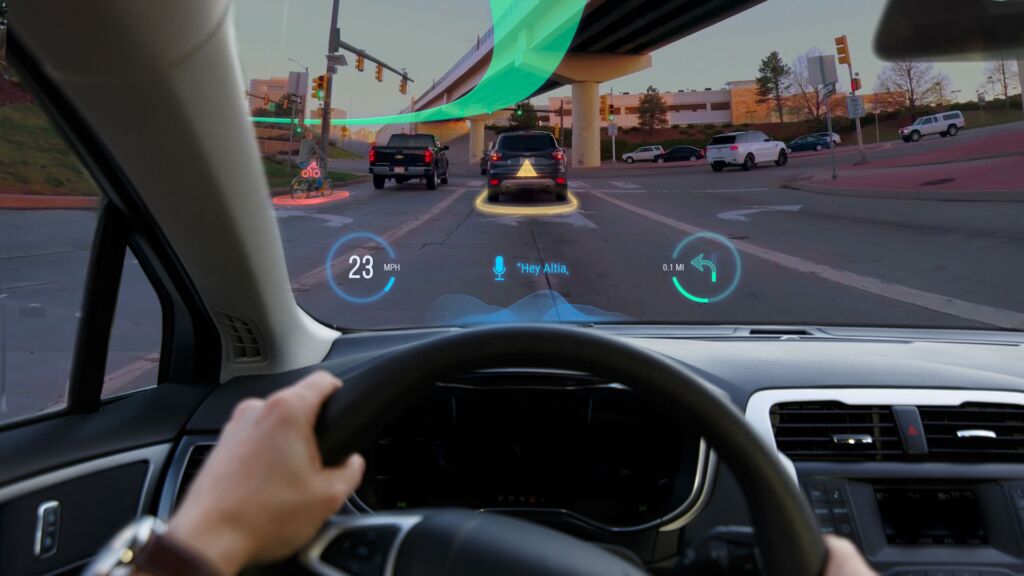
A head-up display (HUD), also called a heads-up display, is a transparent display that shows information in your line of sight so you don’t have to look down. In a car, a HUD projects speed, navigation directions and safety alerts onto the windshield or a small glass panel, so the image appears to float over the road ahead. The name comes from keeping your head up and eyes forward. HUDs started in military aircraft and are now common in cars, with new uses in motorcycles, boats and heavy equipment.
Which cars have head-up displays?
Head-up displays are no longer limited to luxury cars. Many mainstream and luxury brands now offer a HUD, often as part of a higher trim level or technology package, and more electric vehicles are building one into the digital cockpit as standard. The newest systems are augmented reality (AR) HUDs, which line up navigation arrows and safety alerts with the road itself.
Head-up displays beyond the car
卡车和商用车
在1 2021中 福布斯文章,由于我们完整的用户界面软件和显示系统,Altia 被评为 HUD 未来专家。 Altia 首席执行官 Mike Juran 评论说:
“平视显示器将成为自动驾驶和电动汽车的第三条腿……它们将是从驾驶员控制过渡到半自动控制的关键。 这很重要,因为如果驾驶员要暂时控制汽车以阅读文本、查看电子邮件或打瞌睡,那么汽车将能够说,'你最好注意现在因为我处于无法处理的情况。”
Juran 继续阐明将显示的信息类型、图形需要如何显示以及安全性如何是最重要的问题:
“你只想要那里确切需要的信息,而且你最好能够看穿它。 你不能挡住司机的视线。 所以你需要有非常简约和最重要信息的半透明图形。 它不像导航屏幕,您可以在其中播放电影或显示狗的照片。”
HUDs have been on Altia’s project and client lists for a while. In January 2021, Altia Design Research Lab in partnership with Texas Instruments and Ceres showcased a heavy goods electric truck HUD. Autovista Group featured the topic in “平视显示器:噱头还是天赐之物?。
我们的显示器具有“高级驾驶员辅助系统 (ADAS) 警告、桥高信息、电池温度警告、前盲点检测和转弯指示”。 Juran 继续分享他对重型卡车 HUD 的看法。
“将 HUD 与卡车相结合正在解决我们在道路上的一个更大问题,因为它与安全性、生产力和驾驶员参与度有关……如果我们 [只专注于这一点并] 为所有这些重型卡车配备 HUD,然后移动进入乘用车领域,我认为我们将为社会做出巨大的贡献。”
Motorcycles and smart helmets
Riders can’t glance down at a dashboard as easily as drivers can, which makes heads-up information especially valuable on two wheels. Helmet-mounted and visor HUDs show speed, turn-by-turn directions, incoming calls and blind-spot alerts without the rider taking their eyes off the road. These displays run on small, battery-powered hardware, so the GUI has to be lightweight, fast and readable in changing light.
海事 / 船舶
On a boat, the operator is constantly switching between the water ahead and screens for navigation, depth, engine and radar data. A marine HUD brings the most important readings into view, which helps when docking, running at speed or navigating at night. Marine interfaces also have to stay readable in bright sun, glare and spray, which puts a premium on contrast, simple layouts and large, glanceable graphics.
Construction and agriculture equipment
Operators of tractors, combines, excavators and loaders juggle machine status, implement controls and GPS guidance while watching the work in front of them. Head-up displays and transparent overlays can show guidance lines, load and depth readings and safety alerts without pulling attention away from the field or job site. Because this equipment runs long shifts in dust, vibration and bright light, the GUI has to be clear, reliable and fast on rugged embedded hardware.
Head-up display design: what makes a good HUD interface
Good HUD design is mostly about restraint. A head-up display sits on top of the real world, so every graphic competes with the road, the water or the field for the user’s attention. The best HUD interfaces:
- Show only what matters right now: speed, the next turn and urgent alerts, not a full dashboard.
- Use semi-transparent, high-contrast graphics that stay readable in sunlight and at night without blocking the view.
- Keep information at a consistent position and focus distance, so the eye doesn’t have to search or refocus.
- Prioritize alerts clearly, with color and motion reserved for warnings that need action.
- Respond instantly, because a lagging HUD is worse than none.
That last point is also an engineering problem: HUD graphics have to run smoothly on automotive-grade or low-power chips, which is where optimized, production-ready GUI code matters.
Head-Up Display FAQs
What is an AR head-up display?
An augmented reality (AR) head-up display places graphics so they appear to sit on the real world ahead, such as a navigation arrow on the correct lane or a highlight on a pedestrian. Standard HUDs show information at a fixed spot; AR HUDs line it up with what the driver actually sees.
Can motorcycles have head-up displays?
Yes. Motorcycle HUDs are usually built into the helmet or visor, or mounted as a small display near the rider’s line of sight. They show speed, navigation and alerts so riders don’t need to look down at the dashboard.
How are head-up displays used in agriculture and construction?
In tractors, combines and construction machines, HUDs and transparent displays show guidance lines, implement status and safety warnings in the operator’s view, so they can watch the work and the machine data at the same time.
How does Altia help teams build head-up displays?
Altia lets teams design HUD graphics visually in Altia Design or using AI and declarative text with Altia BluePrint, test them on real hardware, and generate optimized production embedded code with DeepScreen. That code runs on automotive-grade and low-power chips, from car HUDs to helmet displays. See our HUD and cluster demos or get free access to Altia.